

8月14日,中国国际电视台(CGTN)聚焦上海算力产业建设发展,专题报道市北国际科创区算力产业实践。上海数据港股份有限公司作为园区核心算力服务商,旗下“上海一号智算中心”的存量焕新升级实践,成为本次报道的典型案例,公司总裁王信菁接受了媒体专访。报道指出,从算力基础设施到实际应用落地,上海正在构建一条日益完整的人工智能产业链。在AI时代,将尖端技术转化为可部署的实际能力,其重要性或许不亚于算力本身。
市北国际科创区是上海人工智能产业生态布局的重要承载载体,为算力产业发展提供了优质的产业土壤与配套支撑。数据港扎根园区发展,充分依托区域产业集聚优势,以技术改造盘活存量数字基础设施资源,打造高密度、高能效、安全可控的智算服务底座,为生物医药、新材料等前沿科研领域提供高性能算力支撑,有效助力科研效率提升与产业成果转化,协同园区加快打造兼具核心原动力与国际竞争力的科创高地。
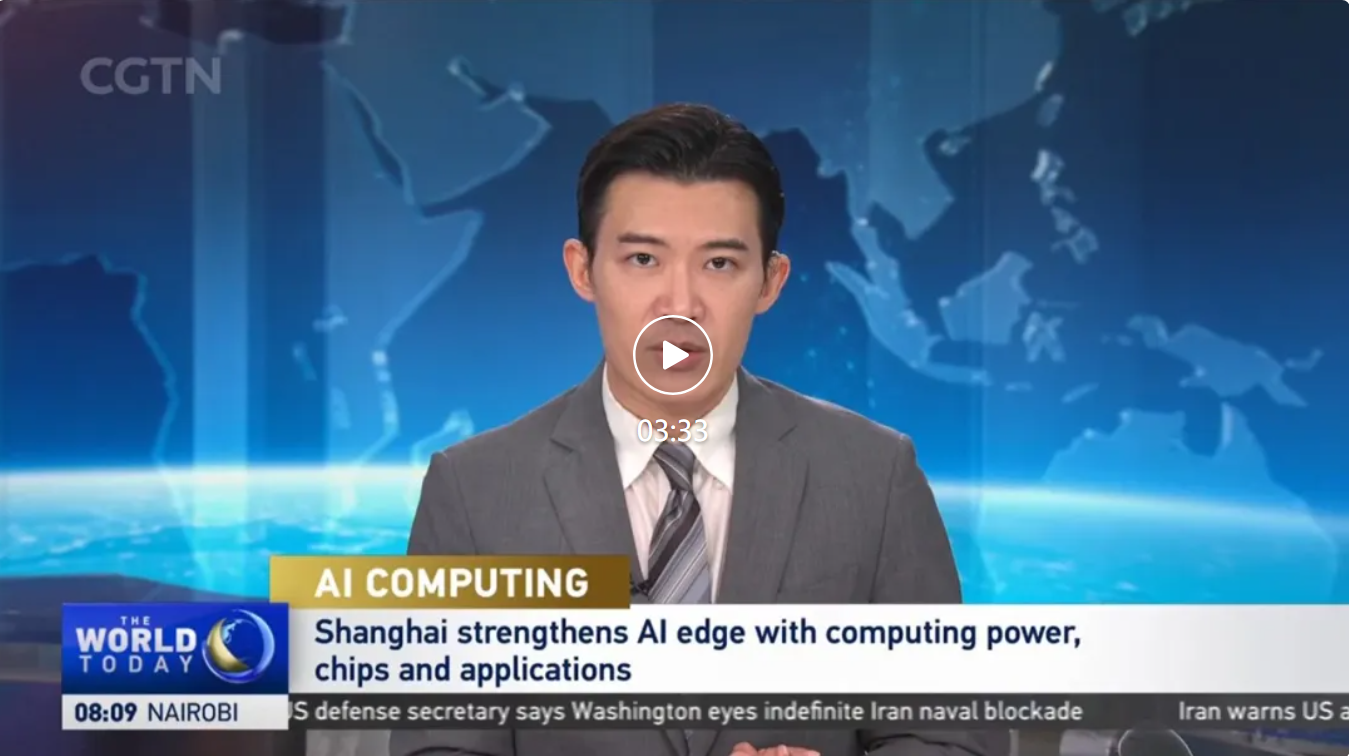
具体报道如下
Computing power is fast becoming a new form of infrastructure. In east China's Shanghai, traditional data centers are being transformed into AI Data Centers.The upgrade is giving existing infrastructure a new role in supporting the AI boom. Bi Ran has more.
At first glance, this looks like just another data center. But behind these familiar rows of server racks, the architecture is changing fast.
This is the Shanghai No. 1 Intelligent Computing Center. Instead of building everything from scratch, the facility is taking another route: turning existing IDC infrastructure into a high-density AIDC.
BI RAN Shanghai "Building an AI data center is not simply about putting more servers into the same room. AI chips require far more power, cooling and network capacity than conventional servers. So it's important to increase computing density within an existing facility."
This AIDC installed denser computing, lower latency and a redesigned infrastructure stack.
Liquid cooling and advanced air cooling systems reduce energy consumption, while a heterogeneous computing platform supports multiple domestic GPU architectures.
That means resources can be optimized for anything from AI training and inference to latency-sensitive financial workloads, and allocated on demand as computing needs change.
WANG XINJING Director & President Shanghai @hub Corporation "Our transformation empowers industries across the board by connecting the entire AI value chain, and ultimately turning that capacity into token consumption and revenue. It creates a complete closed loop from technology investment to commercial value."
Shanghai's Shibei Hi-Tech Park, home to this AIDC, is exploring how existing digital infrastructure can be given a second life.
ZHAO BINGHUI Vice President Shanghai Smart Logic Technology Co., Ltd. "We work closely with Shanghai. Our computing capabilities can support R&D in areas such as biomedicine, new materials, battery electrolytes, lithography and wind tunnel testing, using simulation to improve research efficiency."
The data transmission channels of traditional supercomputers are like one-way flat highways. Data flows are prone to congestion and computational stagnation.
In contrast, the homegrown 3D scientific computer Tianqiong has built a three-dimensional high-speed data network. This enables multi-dimensional and multi-directional simultaneous data transmission, achieving a leap in computing power scheduling and data interaction efficiency.
In drug discovery, developers say it could open up a new paradigm for pharmaceutical R&D.
From computing infrastructure to real-world applications, the city is building an increasingly complete AI value chain. That ability to turn cutting-edge technology into deployable capacity may prove just as important as raw computing power itself in the era of AI. BI RAN, CGTN, Shanghai.
 返回列表
返回列表

